

"AM Isn't the Future. It's Now." Q&A with Marle Tangible


For CEO Adam Clark, additive manufacturing is a current production method, not a future promise. The cofounder of this implant manufacturing company shares business advice and insights in this interview.

Stephanie Hendrixson
Editor-in-Chief, Additive Manufacturing | Manufacturing Connected

From its founding in a garage to its rapid rise to become a leading manufacturer of 3D printed spine implants, Marle Tangible’s arc sounds almost like a fairy tale. But behind its growth, acquisition (the original Tangible Solutions became part of Marle Group in 2022) and continued success is unquestionable dedication and hard work.
We caught up with Adam Clark, cofounder and CEO, to ask about the journey, and what it takes to build an additive business that not only survives, but thrives.
Additive Manufacturing Media (AMM): What was the moment that convinced you that additive manufacturing had promise for medical implants?
 A sample spine implant. The opportunities for improved healing and performance through 3D printed implants spurred Tangible’s entry into additive manufacturing and its specialty with titanium devices. Source: Tangible Solutions
Adam Clark (AC): The moment came during a site visit with an orthopedic OEM who showed us a spinal cage implant design and explained the clinical value behind their lattice design and roughened surface. When we were asked if that was something we could manufacture, we jumped at the opportunity. Ultimately, we decided to focus solely on 3D printed titanium medical devices and to become a world leader in this niche.
That was the moment for us. We could see the design freedom of AM and a real biological impact. Seeing how porous titanium structures could fuse with bone in ways traditional machining couldn’t replicate — that lit the fire. We realized we weren’t just building parts; we were enabling better patient outcomes.
AMM: What was the biggest hurdle to launching Tangible Solutions, and how did you overcome it?
AC: The biggest hurdle was building trust in a new technology in a conservative, heavily regulated industry. Surgeons, OEMs and regulators don’t take chances lightly, nor should they. We had to heavily invest in quality, traceability and validation from Day One.
What helped us overcome it was persistence and transparency. We invited customers into the process to see machines, but to understand the people, the systems and the discipline behind the parts. It took years to build credibility, but it was worth it.

Chris Collins (left) and Adam Clark, chief executive officer, co-founded Tangible Solutions in 2013. Source: Tangible Solutions
AMM: What’s a lesson you’ve learned the hard way in building or scaling your business?
AC: People will make or break your company. It’s not the machines, the software, or the IP. It’s the people.
Early on, I focused so much on technology and not enough on culture. The hard lesson was learning that misaligned or toxic team members can set you back more than a bad investment. Now, we hire for character first, and skill second. I’d rather train someone than try to “fix” a poor teammate.
AMM: From your perspective, what does it take to build a successful business with additive manufacturing?
AC: Three things: vision, discipline and grit.
The vision is what gets you started: seeing how AM can do what traditional methods can’t.
Discipline is what builds the foundation: process control, quality systems and regulatory readiness.
And grit is what keeps you alive, because this is not an easy business. It takes years of iteration, customer education, and capital investment before you see real traction. If you don’t love the process, you won’t make it through the valleys.
AMM: In 2022, Tangible Solutions was acquired by global medical device company Marle Group. What’s the biggest pro of being part of Marle now? Any cons?
AC: The biggest pro is global scale — access to a larger customer base, shared resources, and the ability to think beyond the U.S. market. It gives us a runway to expand our impact.
The biggest challenge has been navigating the pace of a larger organization. We were used to moving fast and independently at Tangible. Now, decisions require more coordination, and that’s forced us to slow down in ways that sometimes feel at odds with entrepreneurial instinct. But it’s also taught me patience and how to lead within complexity.
AMM: What are the biggest constraints you face today — postprocessing, throughput, workforce, or something else?
AC: Honestly, it’s not one thing. It’s the coordination of everything. Throughput and postprocessing are always evolving, but our biggest constraint is workforce: not just finding people, but finding the right people who understand both the precision required in medical manufacturing and the unique demands of AM.
The second is alignment: ensuring that operations, sales and engineering are aligned and working together.
In AM, complexity scales fast, so staying disciplined with systems and communication is critical.

Almost all steps of the additive manufacturing process are found within Marle Tangible’s Fairborn, Ohio, facility. Parts are printed near the front of the building, and then progress through postprocessing steps including wire EDM cut-off, machining, passivation and machining, with hand deburring as one of the last steps. Source: Additive Manufacturing Media
AMM: How is AI impacting your manufacturing operations? Or how will it?
AC: We’re just scratching the surface, but AI has huge potential in additive manufacturing, from real-time machine monitoring and defect prediction to build simulation and quoting automation.
In our case, I see a lot of positive impact on how we can manage part traceability, analyze performance across machines and streamline our quoting process. Long-term, AI could help us close the loop between design, build and postprocess in ways that dramatically reduce waste and cycle time. But right now, it’s about smart integration, not silver bullets.
AMM: What is your advice to a company on the brink of adopting AM?
AC: Understand why you are buying the printer first. Start by understanding the problem you’re solving. Are you optimizing design? Reducing weight? Enhancing biological performance?
AM isn’t a silver bullet; it’s a capability. You need a robust plan for postprocessing, inspection, validation and quality systems before printing in a highly regulated market. Avoid the hype and focus on what adds value.
AMM: Where does additive manufacturing fit in the broad scope of manufacturing?
AC: Additive is the most exciting part of manufacturing right now. It’s also one of the most misunderstood. There’s still a tendency to treat it like a toy or a niche capability when in reality, it’s changing how we think about product development, performance and supply chains.
My mission, and the mission at Marle Tangible, is to prove that AM isn’t the future. It’s now. And if we get it right, we’ll look back and wonder how we ever built implants any other way.
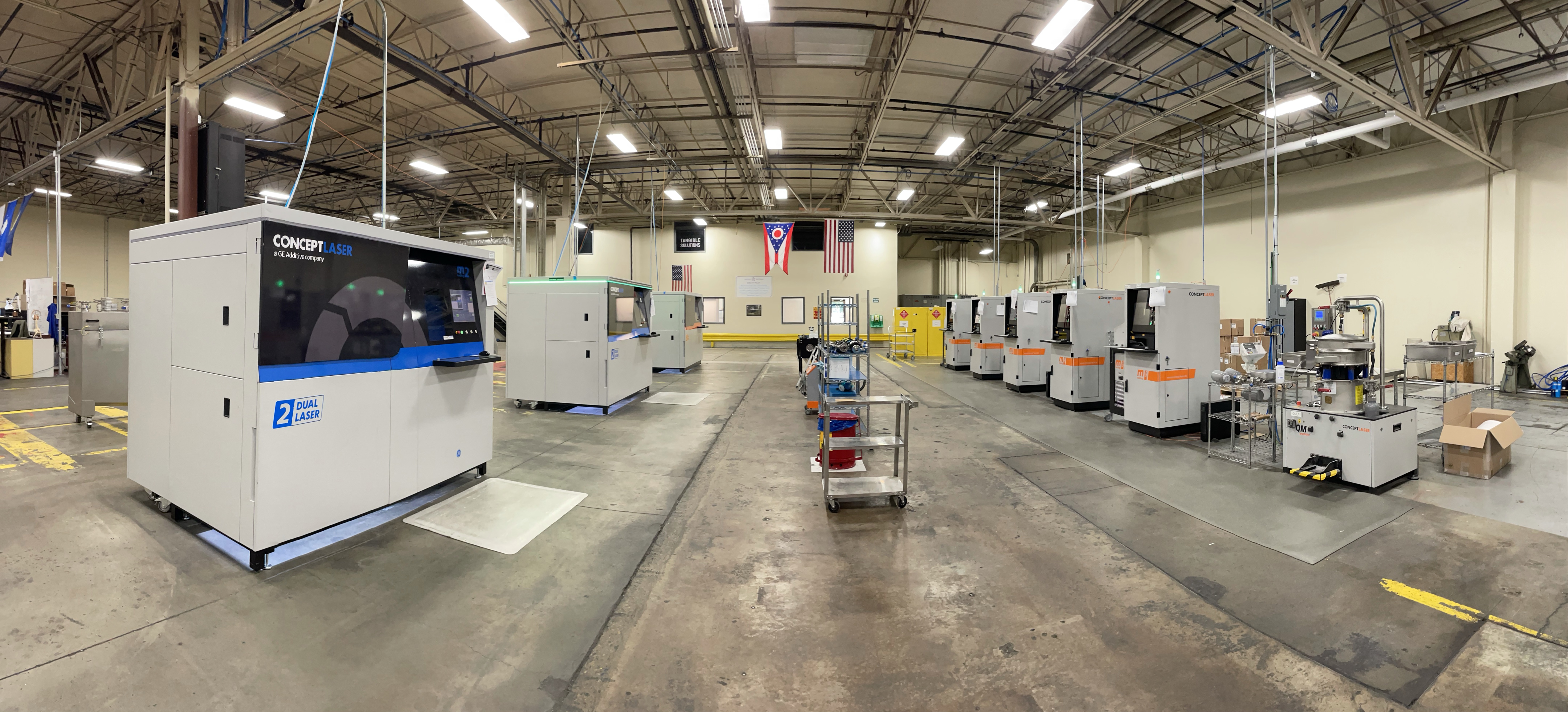
An earlier view of the 3D printing capacity at Tangible’s Fairborn facility. Source: Additive Manufacturing Media